 ×
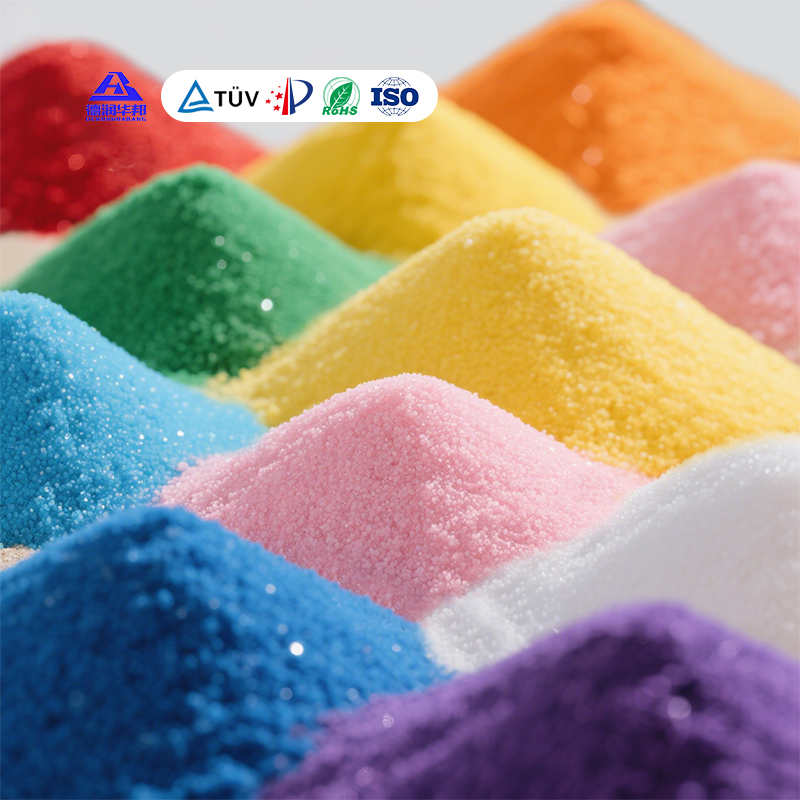
Colored sand is bought on a sample. A buyer holds two bags against a colour card, picks the closer match and orders. That decision fixes the appearance of a facade or a factory floor for a decade, and it rests on the one property all four products share.
Colored sand is not a mineral. It is a commercial term for mineral particles given a controlled colour, and the ways of giving them that colour differ so much that the products share almost nothing beyond the whiteness of the base.
The base can be quartz, marble, granite or basalt. Colour can come from the stone itself, from a pigment film cured onto the surface, or from a pigment fired into it. Grading, dust and moisture are set by processing.
Two bags labelled colored sand can differ in hardness by a factor of two — quartz at Mohs 7 against marble at 3 to 4 — in colour fastness by several grades, and in price by a multiple. None of that is visible in a colour card.
| Route | Temperature | Where the colour sits | Light fastness | How it fails |
|---|---|---|---|---|
| Natural | Crushing and screening only | In the mineral itself | Good; weathers darker over years | Batch-to-batch variation, narrow palette |
| Low-temperature dyed | 150–250 °C cure | A resin or organic film on the surface | Fair to poor; fades first under UV | Pigment migration in solvent systems; film wears through and exposes pale base |
| Sintered or ceramic | 500 °C and above; ceramic routes 700–1,000 °C | Fired into the outer layer | Good; commonly 6 to 7 on the blue wool scale | Energy cost; some pigments cannot survive the kiln |
| Cementitious coated | Ambient to low heat | In an inorganic binder shell | Moderate to good | Alkaline shell can react with acidic binders |
The third row is where most specification errors begin, because the word sintering is used loosely. Sintering means heating until the pigment bonds into the surface, and that starts above 500 °C. A process run at 180 to 220 °C is curing a film, not sintering.
Ask for the process temperature before you ask for the price of colored sand. It is the single figure that separates a product that holds colour on a south-facing wall from one that does not.
The pigments are largely iron oxides, and they do not share a temperature ceiling. Iron oxide red holds its hue to 500 °C and beyond. Iron oxide black oxidises towards brown-red between roughly 300 and 400 °C. Iron oxide yellow begins to lose water and shift towards red from about 180 to 200 °C, with the bulk conversion showing in diffraction work around 250 °C.
A genuinely sintered yellow at 700 °C is therefore a difficult product, not a marketing term: it needs a pigment system designed for the kiln, and the colour differs from a low-temperature yellow of the same shade. A supplier who offers the full palette at every temperature is either using a different pigment chemistry or not running the temperature they quote.
Light fastness is reported on the blue wool scale, where grade 1 fades visibly within weeks and grade 8 is effectively stable. Coated sand for exterior use is normally specified at grade 4 or above; sintered grades reach 6 or 7.
The test separates two failures that look identical on a wall. A faded surface can mean the pigment degraded, or the binding film eroded and exposed the pale mineral underneath. The first appears evenly; the second follows the grain boundaries as speckling. Only the first is fixed by changing pigment.
For solvent-borne systems, add a migration test. A dyed aggregate can pass a light fastness test and still bleed into a white binder when wiped with a solvent, because the film is not crosslinked to the pigment. Sintered and natural products do not.
The product standard is JC/T 2328-2015, Colored sand for building decoration, effective from January 2016 and covering architectural wall and floor finishes. Beyond it, these are the figures that decide whether a delivery works:
One bag of colored sand is not a batch. Natural stone varies across a quarry face, so a showroom sample is a hand specimen, not a production lot. For a continuous facade or a large floor, approve a production batch, agree a colour tolerance in ΔE and keep the approved standard. The standard ages, and it remains the only reference that can be compared against a new delivery, because a photograph cannot.
A colour card cannot show you colored sand in place. Screen rendering and printed charts cannot reproduce how mineral particles behave under a clear binder and a topcoat: much of the finished appearance comes from refraction through the binder and from the surface profile. Approve on a sample panel made with the actual binder and finishing method.
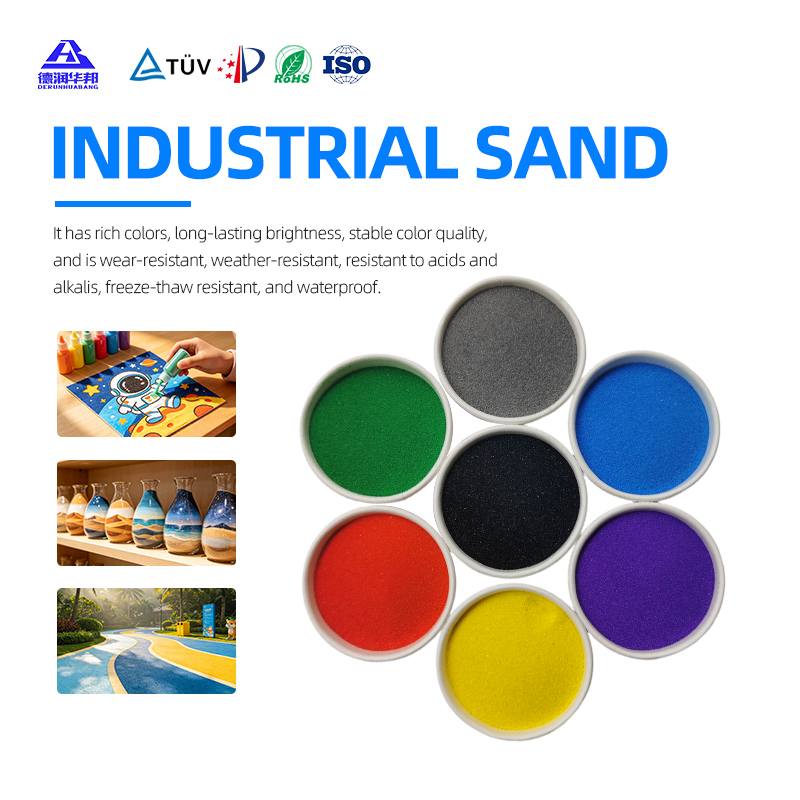
Epoxy and polyurethane floors take coated or sintered quartz, broadcast into wet resin and sealed, so the function is colour plus mechanical body. Grading follows the system: coarse for a heavy-duty build, fine for a thin decorative coat.
Exterior wall coatings and stone-texture paint are where route matters most, because ultraviolet exposure is continuous. Sintered or high-grade natural sand belongs here; a low-temperature dyed sand shows the difference within two summers.
Terrazzo, artificial stone and decorative concrete want hardness and colour contrast, since grinding exposes the grain.
Pool finishes and grout need water and chlorine resistance confirmed on the finished system, and the alkalinity of a cementitious binder checked against the colour layer. Tile grout, usually sold as epoxy grout, is a different product rather than a grade: the aggregate is one component of a formulated joint filler.
Send the application, binder system, exposure condition and grading you need, with any standard your project is specified against. The Huabang team will confirm which colored sand route the application requires, state the process temperature, grading, ΔE tolerance and light fastness grade the material will be supplied against, and say plainly when the colour you have chosen cannot be made by the route your project can afford.


