 ×
Published: November 4, 2026 | Last Updated: November 4, 2026
SEO Title Tag: Salt Room Construction: Gulf Heat and Humidity | Huabang Meta Description: Why salt rooms fail in the Gulf: 75% relative humidity, condensation on cooled walls, chloride corrosion and thermal movement. What to specify instead.
Salt rooms in the Gulf are built in some of the driest air on earth, and they still fail. The reason is not the average humidity of the region but the hours that are not average: coastal summer nights when relative humidity climbs past 80%, the fit-out period before air conditioning is commissioned, and the wall shared with a steam room. Salt is a water-soluble crystal asked to hold a fixed shape for twenty years in a building where the moisture around it swings from 20% to 95%. This guide explains what actually goes wrong, with the numbers a specifier can use.
Sodium chloride is deliquescent. Above roughly 75% relative humidity at room temperature, it begins to absorb water from the air and dissolve in it. Below that threshold it is stable and behaves like a brittle stone.
Gulf coastal cities spend many summer nights above that line. At 35 °C and 80% RH, the dew point is about 31 °C — meaning any surface cooler than 31 °C, which is every air-conditioned salt wall, will collect condensation. That is the mechanism behind most of the complaints: white weeping streaks, salt crust at the base of the wall, and a drip line where the wall meets the floor. It is not a defective shipment. It is the material doing exactly what salt does.
The practical consequence for design: a salt room must be treated as a wet-area-adjacent assembly, not as a dry decorative finish. Vapour control goes on the warm, humid side. The cavity behind the bricks is ventilated or drained, never sealed tight. And the target condition inside the finished room should be stated as a number — typically 45–55% RH at 20–24 °C — rather than left to whatever the building's HVAC happens to deliver.
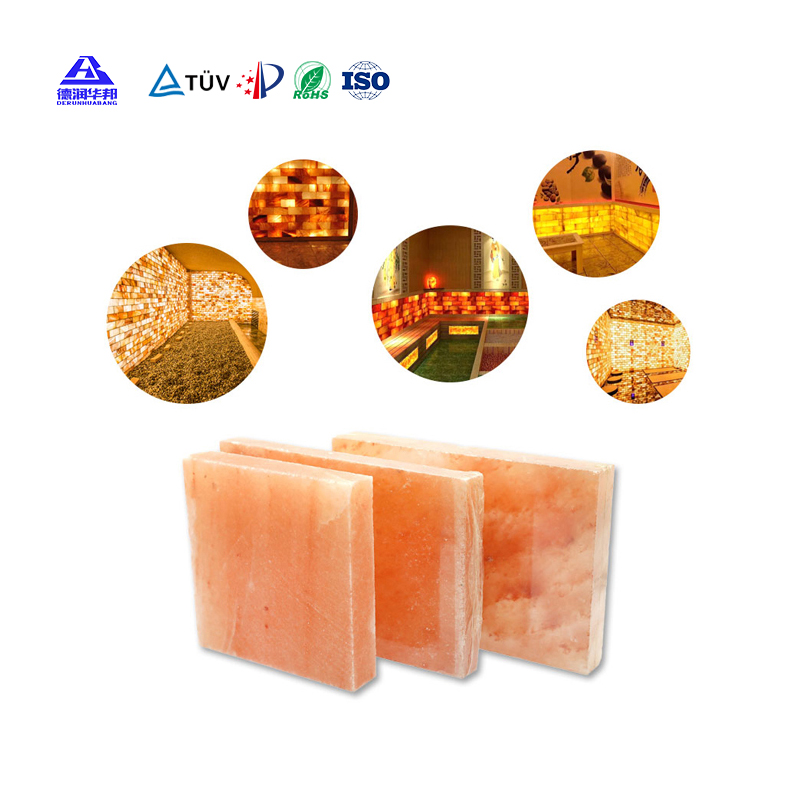
| Failure | Mechanism | What prevents it |
|---|---|---|
| Weeping and efflorescence | Condensation above 75% RH, or moisture migration from the substrate | Vapour barrier on the humid side; ventilated cavity; dehumidification during fit-out |
| Cracking along joints | Salt expands about 40 × 10⁻⁶ per K; a 2 m wall moves roughly 1.6 mm over a 20 K swing | Flexible joints, no rigid bedding, movement gaps at edges |
| Bulging and sagging | Salt creeps under sustained load, faster when moisture is present | Mechanical support behind the bricks; adhesive as a fixing aid, not the only fixing |
| Rusted or stained fixings | Chloride attack on galvanised or 304 stainless | A4 / 316 stainless throughout; no mild steel anywhere in the assembly |
| LED failure and heat spots | Chloride corrosion of the strip, trapped moisture, driver heat | Sealed IP-rated strip, remote driver, no driver inside the salt cavity |
The instinct is to bed salt bricks like any decorative stone: cement adhesive, cement grout. Both are mistakes here. Cement mortar in contact with salt produces efflorescence as soluble salts migrate to the face, and the bond line becomes the place where water sits. The repair is harder than the original installation, because the salt face cannot be cleaned with water.
What works is a salt-compatible adhesive — a PU or epoxy system specified by the adhesive manufacturer for chloride exposure — used to hold the brick while a mechanical fixing carries the load. Grout, if used at all, should be a salt-tolerant pointing material, and a dry-stack detail with concealed fixings avoids the question entirely.
Two properties are routinely ignored. First, thermal movement: the expansion coefficient is roughly 40 × 10⁻⁶ per K, about four times that of concrete. A two-metre salt wall moves around 1.6 mm across a 20 K day-night or on-off cycle, and salt is brittle — it will not absorb that movement the way a flexible stone would. Second, creep: halite deforms slowly under sustained load, and moisture accelerates the process through pressure solution at grain boundaries. A salt wall that is only glued will, over years, follow gravity.
The detail that solves both is the same: a continuous mechanical backing that carries the dead load, with the adhesive doing alignment rather than support, and joints that can move.
Backlit salt walls are the reason most clients want the material, and they are also where the electrical detail matters. An LED strip inside a salt cavity lives in a chloride atmosphere; specify a sealed, IP-rated strip and put the driver outside the cavity, in a ventilated location. A driver mounted against salt will fail early and take the wall with it.
Dust is the other Gulf-specific issue. Fine airborne dust settles into the crystalline surface and cannot be washed off, because washing dissolves the face. The maintenance protocol is dry: soft brush and vacuum, never a wet cloth, and no acidic descaler. A salt room specified without a cleaning method will be cleaned with water by the first contractor who tries.
| Property | Value | Note |
|---|---|---|
| Composition | NaCl 95–98% (decorative grade) | Higher purity for food-contact grades |
| Density | approx. 2.16 g/cm³ | 20×10×2 cm brick ≈ 0.85 kg |
| Compressive strength | low; not load-bearing | Mechanical support required |
| Mohs hardness | 2–2.5 | Cut, drilled and carved on site |
| Thermal expansion | approx. 40 × 10⁻⁶ /K | ~1.6 mm per 2 m at 20 K |
| Deliquescence | approx. 75% RH at 25 °C | The governing design number |
| Solubility | approx. 357 g/L at 25 °C | Why wet cleaning is not an option |
| Reaction to fire | Inherently non-combustible mineral | Confirm the A1 report for the specific product |
| Standard sizes | 20×10×2 / 20×20×2.5 / 30×30×2.5 cm | Custom cutting available |
| Fixing | A4 / 316 stainless, mechanical backing | No galvanised or mild steel |
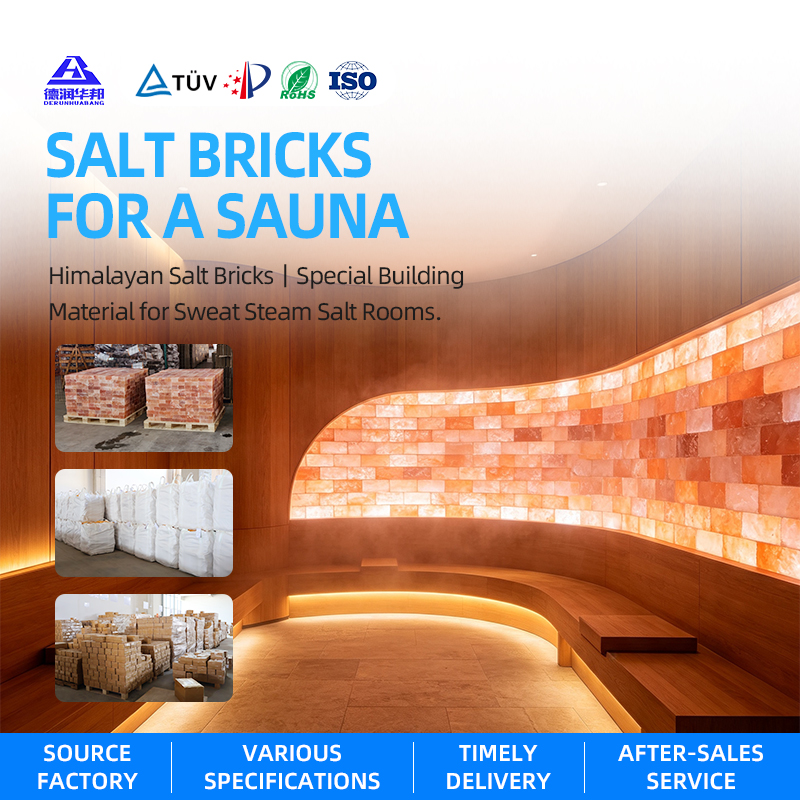
Three details separate a salt room that survives from one that does not. Keep the salt wall out of the direct path of door openings to the exterior, so a humid night does not wash over it. Never place a salt feature on the shared wall of a steam room, shower or pool hall without a full vapour barrier and an independent cavity. And commission the dehumidification before the salt is installed, not after — the fit-out period is when most damage happens, because the building is open, the AC is off, and the salt is already on the wall.
None of this makes salt unsuitable for the Gulf. It makes salt a material that has to be specified rather than merely bought. The projects that fail are almost always the ones where the drawing said "salt wall" and nothing else.
A salt room specification that will survive review usually carries five items beyond the brick itself. The design condition: target temperature and relative humidity, with the dehumidification capacity that maintains it. The vapour control layer: its position, its continuity at floor and ceiling junctions, and who is responsible for it. The cavity: ventilated or drained, and how. The fixing schedule: stainless grade, spacing, and the backing that carries the dead load. And the cleaning regime, written into the handover documents, because the operator will otherwise be told to wipe the wall down.
If a salt room drawing shows only an elevation with a brick pattern on it, the moisture question has not been answered, and in the Gulf it will be answered later by the wall.
Send the room type, the wall area, the substrate, the adjacent spaces and the HVAC design condition. The Huabang technical team will confirm the brick format, thickness and grade for the application, advise on fixings, vapour control and joint details for your climate, and supply samples and test documentation so the assembly can be approved before installation begins.


