×
×
Diatomite, also known as diatomaceous earth or DE, is a porous siliceous mineral material widely used in filtration, absorption, fillers, insulation and selected construction applications. This buyer-focused guide from [Company Name] explains what diatomite is, how natural, calcined and flux-calcined grades differ, which specifications affect industrial performance, and what purchasing teams should verify before placing an order. For importers, distributors and manufacturers, matching the material's pore structure, particle size, permeability, purity and processing grade to the intended application is essential for consistent results.
Diatomite is a soft, fine-grained sedimentary rock formed largely from the fossilized silica skeletons of microscopic aquatic organisms called diatoms. The intricate shells contain networks of pores and channels. After mining and processing, this structure gives industrial diatomite a combination of low bulk density, high porosity, useful surface area and absorption capacity.
The U.S. Geological Survey describes the material as chalk-like, friable, finely porous, low in density and essentially chemically inert in most liquids and gases. It also has low thermal conductivity and a relatively high fusion point. These properties explain why diatomite serves different functions across filtration, absorbents, fillers, insulation, mild abrasives and cement-related products.
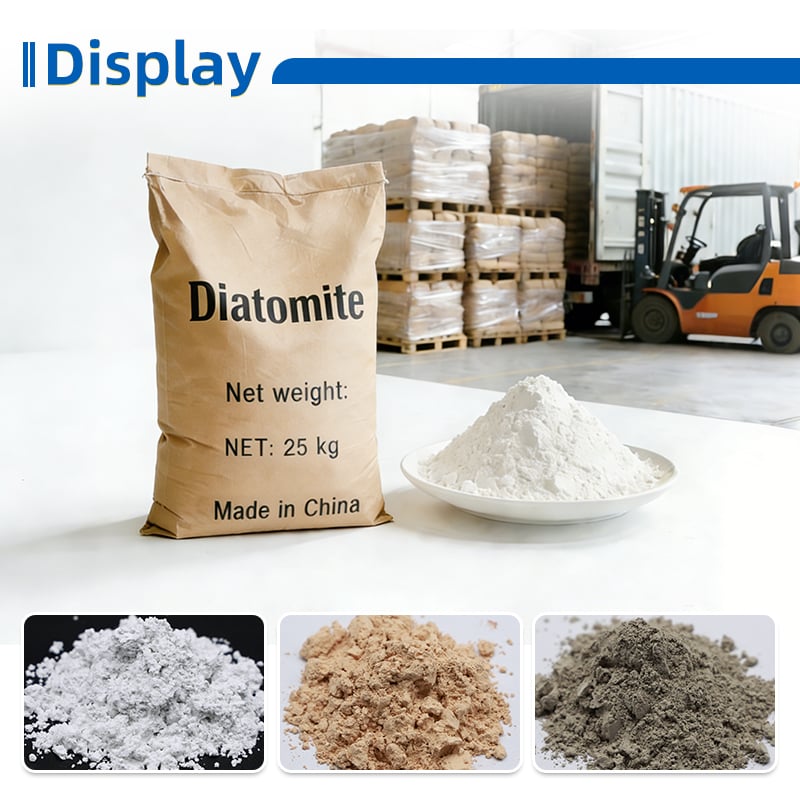
Natural deposits vary in silica content, colour, associated minerals and microscopic structure. Processing can include drying, milling, classification, calcination and flux calcination. Each step changes the finished powder's particle-size distribution, colour, permeability and suitability for a particular application. Buyers should therefore evaluate a specified grade rather than treating all diatomaceous earth as interchangeable.
Natural-grade diatomite is dried, milled and classified without high-temperature calcination. It generally retains more of the original colour and fine-particle distribution of the deposit. Depending on the specification, natural diatomite may be considered for absorbents, functional fillers, agricultural carriers, construction-related products or filtration processes that require a finer cut.
The suitability of a natural grade depends on the deposit and manufacturing process. Purchasing teams should review moisture, particle-size distribution, bulk density, chemical composition and application-specific performance before approval.
Calcined diatomite is heat-treated to remove organic matter and modify physical properties. Calcination can improve brightness and alter particle aggregation, flow behaviour and filtration performance. The resulting grade may be selected when the customer requires a balance of clarity, permeability and controlled particle size.
Heat treatment can also affect the crystalline silica content of the finished material. Buyers should request a current safety data sheet and technical documentation for the exact grade, then follow the applicable occupational exposure and handling requirements in the destination market.
Flux-calcined grades are processed with a fluxing agent at elevated temperature. This treatment produces larger agglomerates and can deliver higher permeability for faster filtration. Such grades may be used where throughput is important and the process can accept the corresponding retention characteristics.
A higher flow rate is not automatically the best result. The appropriate balance among permeability, filtrate clarity and particle retention must be tested with the customer's liquid, equipment and operating conditions.
The microscopic pore network creates a tortuous path that helps capture suspended solids while allowing liquid to pass through a porous filter cake. In precoat filtration, diatomite filter aid can help protect the support medium and establish an even filtration layer. In body-feed use, additional material is introduced during the filtration cycle to maintain cake permeability.
Performance depends on the selected grade and process conditions. A finer grade may support higher clarity but lower flow, while a coarser or more permeable grade may increase throughput but retain fewer fine particles. Buyers should evaluate both clarity and filtration rate rather than relying on mesh size alone.
The porous structure and low bulk density allow industrial diatomite to absorb liquids and serve as a carrier for selected industrial formulations. The USGS lists industrial-spill absorbents and pet litter among established uses. Other formulations may use the mineral to carry active ingredients or improve handling, subject to the technical and regulatory requirements of the finished product.
For absorbent applications, purchasing teams should compare oil or water absorption, bulk density, particle size, dust level and retention performance. The material must also be compatible with the liquid or active ingredient involved.
Industrial diatomite can be incorporated into paints, dry chemicals, polymers and other formulated products as a functional filler. Its porous morphology may influence matting, texture, reinforcement, density and processing behaviour. Because these effects vary by formulation, application trials are necessary before replacing an existing mineral filler.
Low thermal conductivity and a high fusion point support selected insulation and high-temperature uses. Diatomite also serves as a silica additive in cement and other compounds. The required chemistry, particle size and thermal performance depend on the product design, so a construction or insulation grade should be evaluated against the relevant technical standard rather than selected from a generic description.
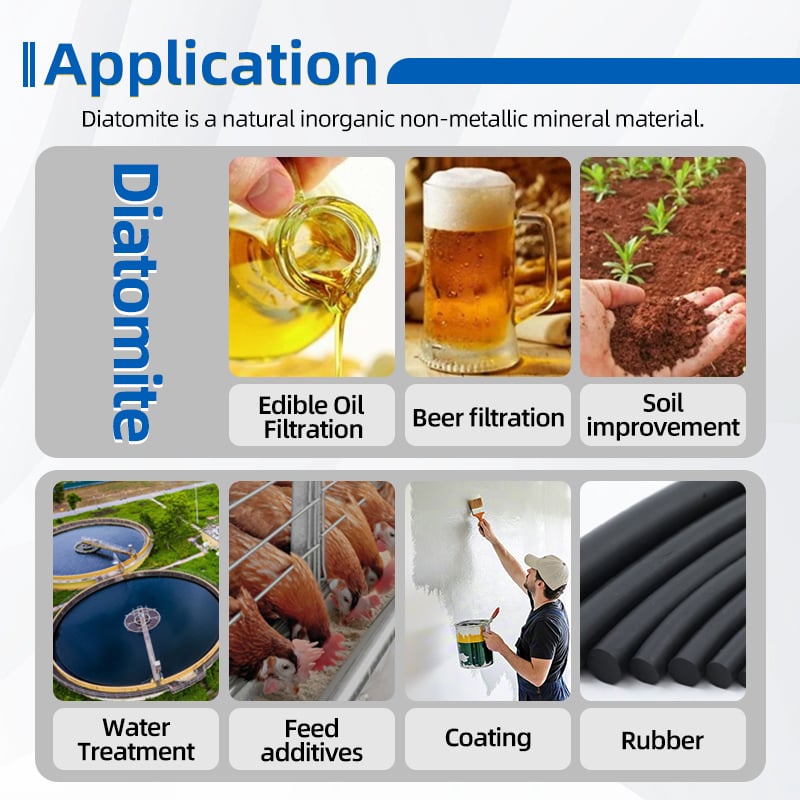
Filtration is a principal industrial use. Diatomite filter aid can support solid-liquid separation in beverage, food, chemical, pharmaceutical, water-treatment and process-liquid systems, depending on grade suitability and regulatory requirements. It can be used as a precoat, body feed or a combination of both.
For diatomite filtration projects, buyers should provide the liquid type, operating temperature, target clarity, solids loading, current filtration rate and equipment information. These details help the supplier recommend a starting grade for laboratory or plant trials. For food, beverage or pharmaceutical use, the buyer must also verify that the selected material and documentation meet the applicable requirements.
Diatomite absorbent products can help manage oil, water and other liquids in industrial or maintenance environments. Important decision factors include absorption capacity, particle size, bulk density, dust control and ease of collection after use. Compatibility and disposal requirements should be checked for the specific liquid being handled.
As a functional filler, diatomite may influence film appearance, matting, texture and formulation density. Paint and coating formulators should test oil absorption, brightness, particle size and dispersion. A grade that works well in one binder system may behave differently in another.
Selected grades are used as carriers, processing aids or absorbent materials in agricultural and animal-care products. These markets can involve specific purity, registration, labelling and safety requirements. Buyers should clearly state the intended use and destination market before requesting a recommendation.
Diatomite can be used as a silica-bearing additive in cementitious products and as a component in selected insulation materials. It also appears in mild abrasives and other specialty formulations. Performance must be confirmed through application testing because deposit quality and processing grade affect the finished material.