



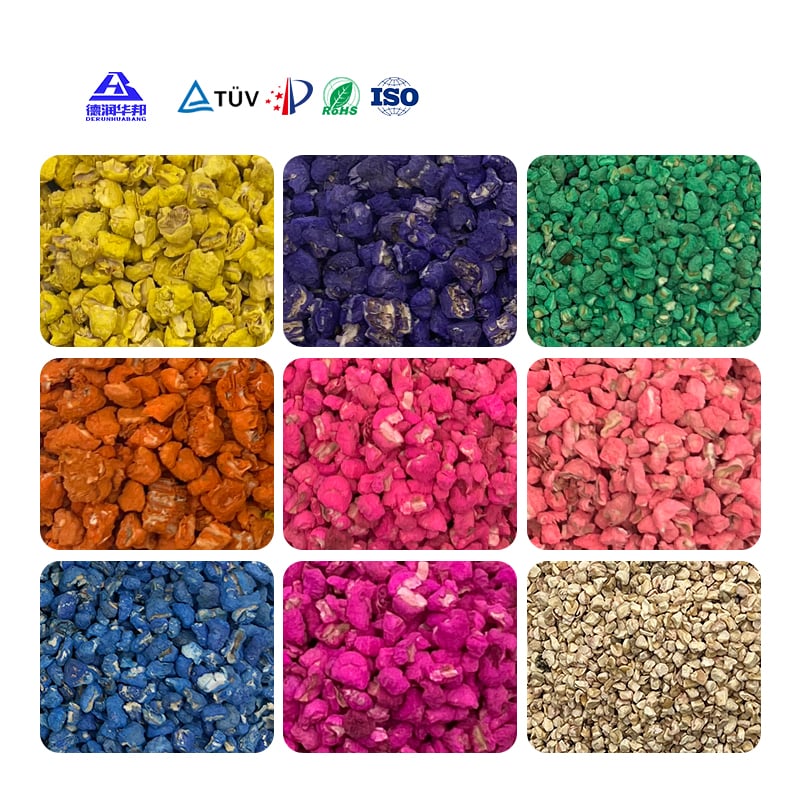
Corn cob granules are biomass granular materials processed from discarded corn cobs after grain threshing through crushing, impurity removal, high-temperature drying and mesh grading. As low-cost biodegradable green adsorption medium and filling material, it is widely used in edible fungus cultivation, agricultural planting substrate, livestock breeding bedding, industrial polishing, sewage and waste gas treatment, rubber and plastic filling industries. It has core advantages of full biodegradation, strong adsorption, loose and porous texture, low bulk density and prominent cost performance.
- Meticulous craftsmanship: Two production paths ensure controllable and traceable quality
- Primary crushing and natural drying processing
Waste corn cob raw materials are simply crushed and sun-dried before screening and classification. The processing cost is low, with a small amount of miscellaneous impurities retained. It is suitable for ordinary breeding bedding, outdoor large-scale soil improvement and low-grade industrial filtration scenarios with cost control as the priority.
- Deep purification and high-temperature sterilization activation
Adopt precise processes including manual sorting impurity removal, high-temperature sterilization, steam pore activation, fiber refinement and precise mesh classification. Agricultural waste corn cobs are fully recycled to realize resource utilization of agricultural residues, complying with circular green agriculture standards. The finished corn cob granules feature uniform particle size, low ash content, no harmful bacteria and insect eggs, strong adsorption capacity, which meet strict standards of edible fungus culture medium, indoor potted substrate, hardware polishing and food-grade auxiliary filtration materials.
- Core Features: Six Major Advantages Underpin "Abundant Value"
- Environmentally degradable and non-toxic, compliant and worry-free
Free of heavy metals, chemical additives and harmful chemical residues, conform to EU REACH, RoHS and national agricultural & food safety standards. It can be completely degraded in natural environment without secondary pollution, safe for crops, livestock and food contact scenarios.
- Weather-resistant and stable storage, long-lasting usability
After high-temperature drying and sterilization treatment, the moisture content is controlled at a low level. It is not easy to mildew, rot and breed bacteria under dry and ventilated storage conditions. The internal porous fiber structure will not collapse after long-term watering, with long service cycle for planting and filtration.
- Weak acid and alkali resistant, mild chemical property
The plant fiber matrix is neutral to slightly weak acid, and will not produce violent chemical reactions with soil, cement, resin and water medium. The property is mild and stable, and will not burn plant roots, scratch workpiece surfaces or damage aquatic organisms.
- Loose porous structure, excellent adsorption capacity
Rich internal capillary pores and large specific surface area, which can efficiently absorb moisture, peculiar smell, grease and tiny suspended pollutants. Low bulk density can reduce the overall weight of the mixed material while achieving deodorization and purification effects.
- Good dispersibility and convenient construction
Uniform granular texture, not easy to agglomerate and harden. It can be directly mixed with cultivation soil, feed, resin and filter fillers in any proportion, adapting to various operations such as mixing, paving, filling and polishing.
- Batch stability and controllable quality
Formal manufacturers adopt standardized production quality control system, strictly control moisture, ash content, particle size and impurity rate of each batch, avoiding planting failure, filter clogging and polishing scratch losses caused by unstable raw material quality.
- Empowering all industries: From basic agriculture to industrial manufacturing, covering all sectors
- Agricultural Breeding and Horticulture Industry
Edible fungus culture medium: loose and breathable, retain water and nutrients to boost mycelium growth and yield;Indoor potted flowers and vegetable seedling substrate: prevent soil hardening and root rot, improve seedling survival rate;Livestock and pet breeding bedding: absorb excrement odor, reduce ammonia concentration in breeding houses.
- Plastics and Rubber Industry
Degradable plastic filler, composite rubber auxiliary material: reduce raw material cost, realize lightweight products and improve full biodegradability.
- Industrial Polishing and Environmental Protection Treatment
Hardware, jewelry, leather polishing medium: moderate hardness, no scratches on workpiece surface;Sewage and waste gas deodorization filter material: adsorb organic odor and suspended pollutants for environmental purification.

