


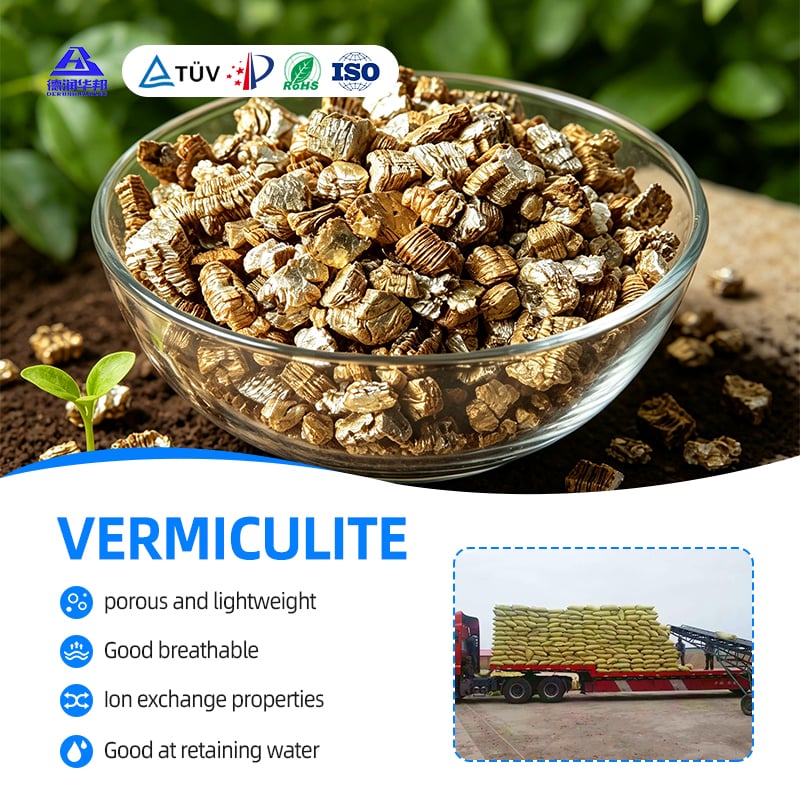
Amid global carbon neutrality roadmaps, stricter fire safety regulatory standards, widespread lightweight transformation across manufacturing sectors, and rising market demand for cost-effective, high-temperature resistant mineral additives, vermiculite powder — chemically hydrated magnesium-iron-aluminum silicate with the molecular formula (Mg,Fe²⁺,Fe³⁺)₃(Al,Si)₄O₁₀₂·4H₂O — is refined from premium layered vermiculite ores via closed-circuit ore sorting, high-temperature exfoliation and ultrafine micronization workflows. It has evolved from a basic horticultural lightweight aggregate into a high-value, multifunctional core eco-mineral material. Far beyond serving merely as a heat-insulating filler for construction and polymer substrates, surface-activated vermiculite integrates narrow-distribution particle classification, silane coupling agent surface modification and full-spectrum heavy metal impurity removal purification processes. It simultaneously delivers lightweight reinforcement, permanent thermal barrier, halogen-free flame retardancy, sound absorption, high liquid adsorption and full-lifecycle raw material cost reduction performance. Widely recognized as a universal sustainable mineral foundation for modern polymer composite, fire-resistant coating, rubber friction component, new energy lithium battery and green construction engineering sectors, vermiculite boasts distinctive competitive edges in exfoliable layered barrier performance, ultra-low thermal conductivity, chemical inertness and full recyclability. It facilitates cross-industry low-carbon upgrading while drastically cutting raw material expenditure for manufacturers worldwide.
The core competitive advantage of premium surface-modified exfoliated vermiculite powder lies in high-purity ore screening and precise closed-loop exfoliation production lines. Industrial qualified vermiculite is sourced primarily from low-impurity layered vermiculite deposits with minimal asbestos, iron, manganese and heavy metal contaminants. Multi-stage magnetic separation, airflow ultrafine grinding and controlled medium-temperature exfoliation (870–1000°C) are deployed to eliminate colored heavy metal impurities, restricting total foreign matter content below 0.22% and attaining mineral purity of no less than 98.8% for high-end grades, alongside consistent whiteness index above 92. High-performance customized products are manufactured through low-temperature dry surface activation and narrow-span particle grading technologies, delivering tailor-made particle size specifications ranging from 20–325 mesh coarse expanded granules for horticulture, lightweight mortar and fireproof plaster applications to 1250–8000 mesh ultrafine vermiculite powder for high-temperature automotive polymers, lithium battery separators and halogen-free flame-retardant plastic compounding. Its particle size uniformity reaches 99.3%, with inter-batch performance deviation controlled within 0.6%. Thermally stable up to 1100°C, finished exfoliated vermiculite retains intact accordion-like layered crystal structures and features an ultra-low thermal conductivity coefficient (0.05–0.07 W/m·K), effectively blocking heat transfer and suppressing thermal shrinkage, thermal runaway and deformation of polymer substrates under continuous high-temperature molding or fire exposure. Chemically inert against oxidation, UV degradation, weak acid and alkali corrosion, asbestos-free and heavy-metal-free vermiculite formulations fully comply with REACH, RoHS, WEEE, EU Construction Products Fire Safety Regulation and global agricultural & environmental safety standards, establishing vermiculite as a benchmark eco-friendly, cost-efficient thermal barrier mineral filler for global industrial production.
Endowed with inherent exfoliable layered flame retardancy, rigid lightweight reinforcement and cost-reduction mineral characteristics, vermiculite powder demonstrates broad-spectrum industrial applicability, solving longstanding technical bottlenecks in polymer composite manufacturing, fire-resistant architectural coating production, rubber friction component processing, new energy battery fabrication, as well as environmental governance and horticultural raw material sectors.
Within automotive, wire & cable and polymer composite manufacturing, surface-treated ultrafine vermiculite acts as a core lightweight flame-retardant modifier for polypropylene automotive interior components, LSZH low-smoke zero-halogen cable insulation layers, PVC fireproof plastic profiles, EVA foams, household appliance housings and biodegradable PLA packaging materials. When incorporated into polyolefin substrates at a loading ratio of 18%–32%, its unique accordion-layer crystalline structure forms dense thermal isolation networks inside polymer matrices, boosting flexural modulus by over 38% and elevating thermal deformation temperature from 98°C to above 132°C, thereby drastically reducing molding shrinkage and dimensional distortion of finished plastic products. Upon open flame exposure, vermiculite instantly exfoliates and expands 5–10 times its original volume to form a dense carbonized barrier layer, cutting flammable gas release and achieving halogen-free Class V0 flame retardancy without toxic smoke emission. Compared with high-cost glass fiber, precipitated barium sulfate and synthetic flame retardant fillers, vermiculite slashes raw material costs by 40% and achieves a 9%–13% weight reduction of end products, without inducing abrasion to extrusion and injection molding equipment. Vermiculite-reinforced modified polymers exhibit superior scratch resistance, anti-aging performance and electrical insulation capacity, extending the design service life from 7 years for unfilled conventional plastics to over 24 years for lightweight automotive structural and fireproof parts. Major national infrastructure projects, including new energy vehicle interior trim, high-speed rail fire-resistant cable casings and plastic structural components for large data centers, have widely adopted this mineral filler. Approximately 0.28 tons of vermiculite is consumed per ton of modified automotive flame-retardant polymer, significantly alleviating the global plastics supply chain’s reliance on high-priced synthetic flame retardant feedstocks.
In architectural fireproof coatings, acoustic insulation plaster and green construction engineering, high-purity surface-activated vermiculite powder serves as a fundamental functional raw material for exterior weather-resistant fire retardant coatings, thermal insulation anti-crack mortar, flame-retardant aluminum composite panels and high-rise passive fire protection putty. Standard 1250-mesh graded vermiculite features moderate filling activity, outstanding suspension dispersion and dual vapor & heat barrier capacity, effectively enhancing coating hiding power, scrub resistance and fire endurance while lowering titanium dioxide consumption by 15% to curtail coating raw material expenses. Surface-modified vermiculite compounded with anti-yellowing additives maintains consistent whiteness and uniform texture for more than 13 years under continuous outdoor solar irradiation, without chalking, fading or discoloration, and extends building fire resistance rating up to 4 hours under standard fire test conditions. It satisfies differentiated aesthetic, thermal insulation, anti-corrosion and fire safety requirements for commercial high-rises, public sports facilities and residential landscape projects. Relative to imported high-performance synthetic thermal insulation extenders, vermiculite-based architectural coating formulations reduce raw material expenditures by 46% and cut production carbon emissions by over 52%, fully aligning with international green low-carbon building certification criteria.
In rubber, brake friction lining and waterproof membrane manufacturing, fine activated vermiculite functions as a multifunctional reinforcing filler, lubricating processing aid and halogen-free anti-aging stabilizer modifier. For mine conveyor belts, fire-resistant rubber hoses, automotive brake linings and waterproof coiled material production, appropriately surface-modified vermiculite can substitute up to 22% of high-cost reinforcing precipitated silica and asbestos friction materials without compromising tensile strength, abrasion resistance and anti-aging performance. It elevates the dimensional stability grade of finished rubber products by three tiers and reduces overall manufacturing costs by nearly 33%, amid sustained price volatility of global white functional mineral fillers. For waterproof engineering materials, vermiculite’s dense exfoliated layered barrier impedes infiltration of water, oxygen and acidic corrosive media, slowing the hardening and cracking of rubber membranes and extending the waterproof service life of roof and underground engineering works by more than a decade. It is also extensively deployed in mechanical shock-absorbing sealing strips and cable rubber gaskets, leveraging its intrinsic insulating and lubricating properties to mitigate high-temperature failure risks of industrial equipment and elevate overall production safety standards.
In new energy, environmental governance, horticulture and feed functional material sectors, vermiculite powder expands its sustainable application boundaries to facilitate lightweight upgrading and clean production optimization. Within lithium battery manufacturing, ultrafine high-purity vermiculite nanosheets are coated onto battery separators to enhance thermal shutdown safety and puncture resistance, effectively restraining thermal runaway of lithium cells and prolonging battery cycle life by 18%–25%. Demand for vermiculite in the new energy power storage sector is projected to register a compound annual growth rate exceeding 10.8% from 2026 to 2032. For paper coating production, soft high-brightness ultrafine vermiculite improves paper surface smoothness, ink absorbency and water retention barrier performance, reducing dye consumption and substituting high-cost kaolin for lightweight coated printing paper. Horticulture-grade exfoliated vermiculite with ultra-low heavy metal content is deployed as soil conditioner, water retention substrate and anti-caking carrier for livestock feed additives, complying with stringent agricultural and feed contact safety specifications. Its application scope extends from basic industrial thermal insulation extenders to high-end energy storage, environmental remediation and agricultural manufacturing fields.
Driven by global lightweight manufacturing policies and continuous low-carbon technological innovation across downstream industries, the vermiculite mineral processing sector has entered an era of high-value, standardized development. Technological breakthroughs in low-energy airflow ultrafine grinding, low-temperature silane surface activation and intelligent closed-circuit ore sorting have transformed vermiculite from low-margin bulk insulation aggregates into customized high-value functional mineral fillers, meeting stringent industrial specifications for particle size precision, batch consistency, polymer compatibility and non-toxic environmental compliance. Modern automated fully enclosed production lines adopt zero-discharge wastewater circulation systems, low-carbon renewable energy heating for exfoliation and full-process dust recovery facilities, achieving zero discharge of heavy metal wastewater and over 98.5% resource recovery efficiency for vermiculite ore feedstocks. As the world’s largest reserve base and finished product manufacturing hub for vermiculite, China possesses a complete industrial chain covering clean ore exploitation, intelligent high-temperature exfoliation, in-depth surface modification and global end-user export supply, holding approximately one-third of the world’s proven vermiculite reserves. High-purity surface-modified exfoliated vermiculite manufactured domestically is exported to over 80 countries and regions across Europe, North America, Southeast Asia, Oceania and the Middle East, accelerating the global replacement of high-priced imported synthetic thermal barrier and flame retardant fillers and advancing the development of circular economy and low-carbon industrial systems worldwide.
Against the backdrop of global industrial lightweight transformation and green manufacturing upgrading, the strategic value of vermiculite powder continues to rise year-on-year. It provides a renewable, low-carbon and cost-effective mineral alternative to high-consumption, high-priced synthetic flame retardant and thermal insulation additives, perfectly aligning with industrial development objectives of lightweight performance enhancement, production cost reduction and waste resource recycling. Industrial research data indicates that the global vermiculite powder market scale surpassed USD 0.47 billion in 2025, while China’s domestic market volume exceeded RMB 96 billion, fueled by mandatory lightweight vehicle fire safety standards, growing investment in architectural passive fire protection infrastructure and expanding demand for new energy lithium battery storage worldwide. Market analysts forecast that the market size of high-purity surface-modified functional vermiculite will exceed RMB 530 billion by 2032, as downstream industries including automotive flame-retardant polymers, lithium battery separators, fire-resistant architectural coatings, rubber friction components and horticultural substrates continuously raise requirements for recycled mineral fillers in terms of thermal stability, safety and carbon footprint control.
From a low-cost horticultural lightweight aggregate that alleviates global manufacturing raw material cost pressures to a core multifunctional thermal barrier mineral material supporting modern low-carbon fireproof lightweight green manufacturing, vermiculite powder exemplifies how natural exfoliable layered magnesium-aluminum-iron silicate mineral resources can deliver long-term industrial, environmental and economic triple benefits through sophisticated purification, controlled exfoliation and surface modification technological upgrades. No longer categorized as a low-value secondary ore byproduct, vermiculite powder serves as a pivotal sustainable pillar for constructing a lightweight, non-toxic, circular and high-performance global industrial ecosystem, guiding polymer manufacturing, fireproof coating engineering, rubber friction processing, new energy storage and agricultural horticulture industries worldwide toward resource-efficient, eco-friendly and cost-optimized long-term development.

