 ×
Iron oxide yellow is the one grade in the family that has a temperature it cannot cross. Red survives calcination because it is already the calcined form. Black is stable enough for most polymer work. Yellow is a hydrate, and heat removes the water.
This guide is about that ceiling: where it sits, why it is lower than most buyers assume, and how to specify it so the question gets answered before a tonne of compound is scraped.
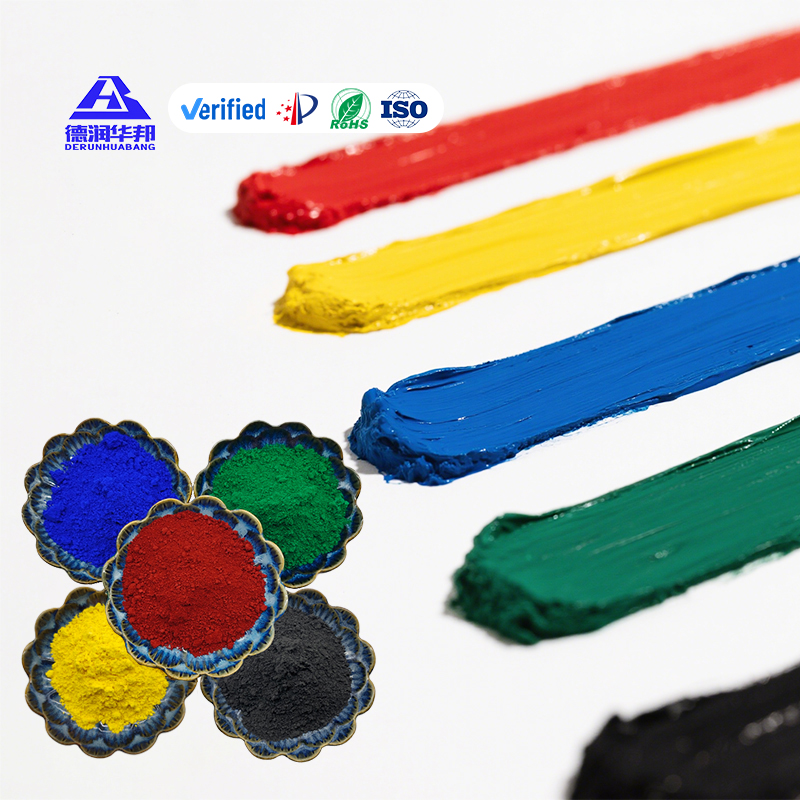
Iron oxide yellow is α-FeOOH, goethite — an iron oxide hydroxide, not an iron oxide. Every yellow shade in the family carries chemically bound water in its crystal structure. Heating drives that water off:
2 α-FeOOH → α-Fe₂O₃ + H₂O
The product is hematite, which is iron oxide red. The reaction is not a reversible drying step. Once the water is gone, cooling does not bring the yellow back. The batch is red, at whatever intermediate shade the conversion reached.
Two temperature figures circulate, and they are often quoted against each other as if one must be wrong:
Both are correct and they describe different events. The colour moves before the phase change is complete, because even a small fraction of red hematite forming inside a yellow particle shifts the hue perceptibly. The phase is still mostly goethite; the colour is already wrong. For a formulator working with iron oxide yellow, the first number is the one that matters, and the second explains why nobody can promise a sharp threshold — the conversion is gradual, so "heat resistant to 200 °C" is a statement about a test, not a property.
| Chemistry | Crystal form | Ceiling in air | Failure mode | |
|---|---|---|---|---|
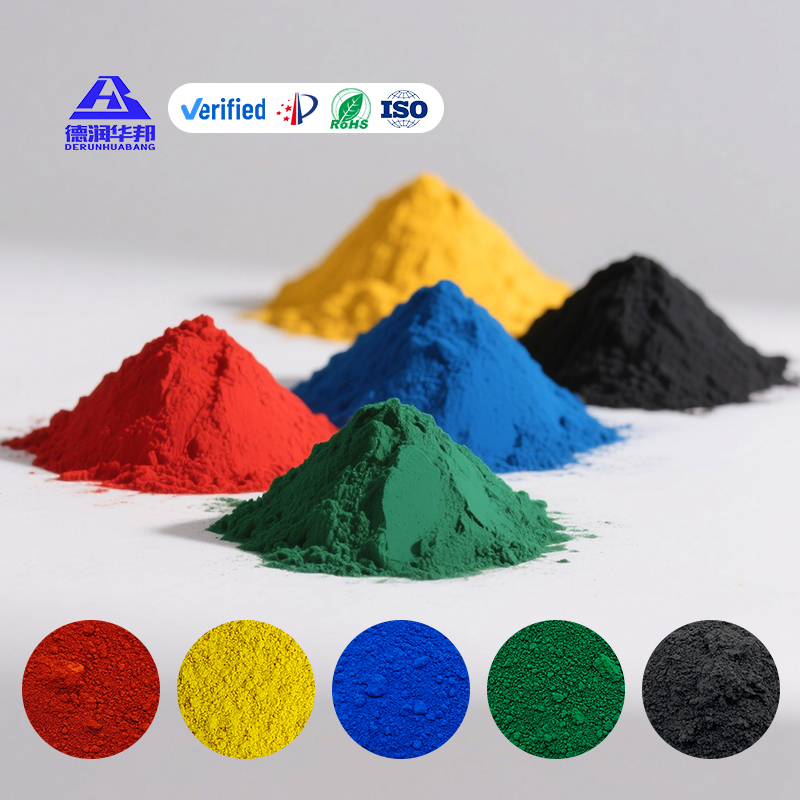
| Iron oxide red | α-Fe₂O₃, hematite | Platy to granular | 500–800 °C for calcined grades | Very little; the stable end member |
| Iron oxide yellow | α-FeOOH, goethite | Acicular, needle-shaped | Visible shift from ~180–200 °C; bulk conversion near 250 °C | Dehydrates to red; irreversible |
| Iron oxide black | Fe₃O₄, magnetite | Near-cubic | Oxidises from roughly 300–400 °C | Turns brown-red as it becomes hematite |
| Iron oxide brown | Blend of the above | Mixed | Set by the lowest component | Shades separate; the yellow part goes first |
The table is also the answer to a common sourcing question. A buyer comparing three grades on Fe₂O₃ content alone will see similar numbers and conclude they are interchangeable at temperature. They are not, because the number describes iron content and says nothing about whether that iron is carrying water.
Set the ceiling beside the equipment it has to pass through:
So iron oxide yellow belongs in PVC, in EVA, in low-bake coatings, in concrete and in applications with no thermal exposure at all. It does not belong in engineering polymers, and the fact that a yellow grade is cheaper per kilogram than a high-temperature yellow is not a reason to try.
One variable is routinely left out of the decision: residence time. A barrel set at 190 °C with four minutes of dwell is a harsher environment than a head that touches 210 °C for a few seconds. Heat history is temperature multiplied by time, and the second factor is the one nobody puts on a data sheet. If a yellow has passed at a given setpoint in a short-cycle process, that result does not transfer to a long-residence twin-screw line at the same setpoint.
The pigment price is the smallest number in this calculation. Three worked examples, using typical dosages:
Concrete. Iron oxide yellow is dosed at roughly 2–5% of cement mass, toward the upper end for deep shades. A mix at 350 kg/m³ of cement therefore carries about 7 kg/m³ at 2% and 17.5 kg/m³ at 5%. Concrete is not a thermal process, so yellow is normally safe here — the calculation matters because it shows the scale at which dosage errors multiply. A half-point dosage error across a 500 m³ pour — 2.5% instead of 3% — moves 875 kg of pigment and leaves a visible colour break between pours.
Plastics. Iron oxide yellow is typically loaded at 0.5–2% of the compound. At 1% by weight, one tonne of compound carries 10 kg of pigment. If the iron oxide yellow shifts in the barrel, that 10 kg has taken 990 kg of polymer with it. This is the arithmetic that makes a heat-stability test cheaper than a trial run.
Coatings. Iron oxide yellow at 5–20% of formula weight; at 10%, a one-tonne batch holds 100 kg. Here the failure is usually not full conversion but a batch-to-batch ΔE drift after a bake oven runs hot, which shows up as a colour complaint three weeks later rather than on the line.
"Heat resistant" is not a specification. Ask for the iron oxide yellow grade's behaviour as a measured result:
Where the application genuinely needs yellow above 200 °C, the answer is not a better iron oxide yellow grade — it is a different chemistry. Bismuth vanadate yellow and nickel-antimony-titanate yellows are the usual routes, and both cost more per kilogram and bring their own regulatory file. Recommending them is not a sales argument for iron oxide; it is the reason a supplier should say plainly when iron oxide yellow is the wrong material.
Send the polymer or binder, the maximum melt or bake temperature, the residence time at that temperature, and the shade you are matching. The Huabang technical team will confirm whether an iron oxide yellow grade fits the window, or say so if it does not — and supply loss-on-ignition and heat-stability data with the sample so the grade can be checked in your own process rather than ours.


