 ×
×
Iron oxide pigments are durable inorganic colorants used in concrete, paving products, paints, coatings, plastics, rubber, ceramics and other manufactured materials. This buyer-focused guide from [Company Name] explains the differences among red, yellow, black and brown grades, compares natural and synthetic products, and identifies the properties that influence color consistency, dispersion, heat stability and processing. For importers, distributors and formulators, selecting suitable iron oxide pigments requires more than matching a photograph or color name: the product must be evaluated in the actual binder, cement or polymer system.
Iron oxide pigments are inorganic materials based on iron oxides or iron oxide hydroxides. Their color depends on chemical composition, crystal structure, particle dimensions and production conditions. Common commercial families include red iron oxide, yellow iron oxide, black iron oxide and blends that produce brown or other earth-tone shades.
Natural iron oxide pigments are obtained from mineral deposits and processed through crushing, washing, separation, drying and milling. Synthetic iron oxide pigments are manufactured under controlled conditions to achieve more consistent chemistry, particle characteristics and color. Both categories can be useful, but they should not be treated as interchangeable without testing.
Unlike dyes that dissolve in a medium, these pigments are insoluble particles that must be distributed through a binder or matrix. Dispersion therefore has a major effect on final color, tint strength, gloss and surface quality. Even a technically suitable pigment may produce poor results when mixing energy, dispersant or formulation balance is inadequate.
Red iron oxide pigments are commonly associated with hematite-type ferric oxide. Shades can range from yellowish red and bright red to deeper blue-shade red, depending on particle characteristics and manufacturing route. Red iron oxide pigments are widely used in concrete, pavers, roofing products, primers, coatings, plastics and rubber.
For construction uses, the pigment must disperse evenly through the cementitious mix and maintain repeatable color from batch to batch. For coatings or plastics, fineness, undertone, heat exposure and binder compatibility can become more important.
Yellow iron oxide pigments are generally based on iron oxide hydroxide. It provides yellow and ochre shades for construction materials, paints, coatings and plastics. The particle morphology and surface characteristics differ from red grades, which can affect oil absorption, viscosity and dispersion.
Yellow iron oxide pigments may change color if exposed to temperatures beyond the grade's thermal stability. Plastics and high-temperature processes should therefore use a product with documented heat behaviour under relevant processing conditions.
Black iron oxide pigments are commonly based on magnetite-type material. It is used to create black, grey and dark shades in concrete, coatings, plastics and other formulations. Tinting strength, undertone and heat stability vary by grade.
Buyers should distinguish black iron oxide pigments from carbon black. The two materials have different chemistry, density, tint behaviour and application properties. Substitution requires formulation testing rather than a visual comparison alone.
Brown iron oxide pigments are commonly produced from controlled combinations of red, yellow and black components or through dedicated manufacturing processes. Blends allow formulators to achieve earth tones, beige, tan and customized shades for architectural products.
Color consistency depends on both the component pigments and blend uniformity. For large projects, buyers should approve a physical standard and agree on measurable color tolerance before production.
Very fine or specially engineered transparent iron oxide pigments can create transparent or translucent effects in selected coatings, wood finishes and automotive systems. Other grades are designed for processing at elevated temperatures in plastics or specialty materials.
These products have application-specific requirements and should be selected with data on particle size, transparency, heat stability, dispersibility and binder compatibility. A standard construction grade should not be assumed suitable for a transparent coating or high-temperature polymer.
Iron oxide pigments are valued for stable, long-lasting color in many exterior and industrial applications. The inorganic nature of iron oxide pigments supports resistance to light and weathering when the grade is correctly selected and incorporated into a suitable finished system.
Durability claims must still be evaluated in context. Binder quality, cement chemistry, dosage, surface finish, exposure and maintenance all influence final appearance. The pigment is one component of the complete product.
Red, yellow, black and brown iron oxide pigments can be used individually or blended to create a wide range of earth tones. This makes them useful for architectural concrete, pavers, masonry, decorative coatings and polymer products that require repeatable color families.
A digital image cannot accurately represent every shade. Lighting, screen settings and surrounding colors alter perception, while wet and dry materials can look different. Buyers should approve a physical sample or finished panel.
Selected iron oxide pigments perform in alkaline cementitious systems and many coating or polymer formulations. Some grades offer suitable heat stability for plastic processing, while others may undergo color changes at elevated temperatures.
The required test depends on the application. Concrete buyers may focus on alkali stability and weathering; plastics buyers may prioritize thermal stability and dispersion; coating manufacturers may examine oil absorption, rheology, gloss and chemical resistance.
These pigments can provide strong coloration at controlled dosage, but the lowest purchase price does not always deliver the lowest formulation cost. Tinting strength, dispersion, dosing accuracy and batch consistency affect the amount needed and the rate of rejected production.
Lower-strength iron oxide pigments may require a higher loading to reach the target shade. Buyers should compare cost-in-use through controlled trials instead of price per tonne alone.
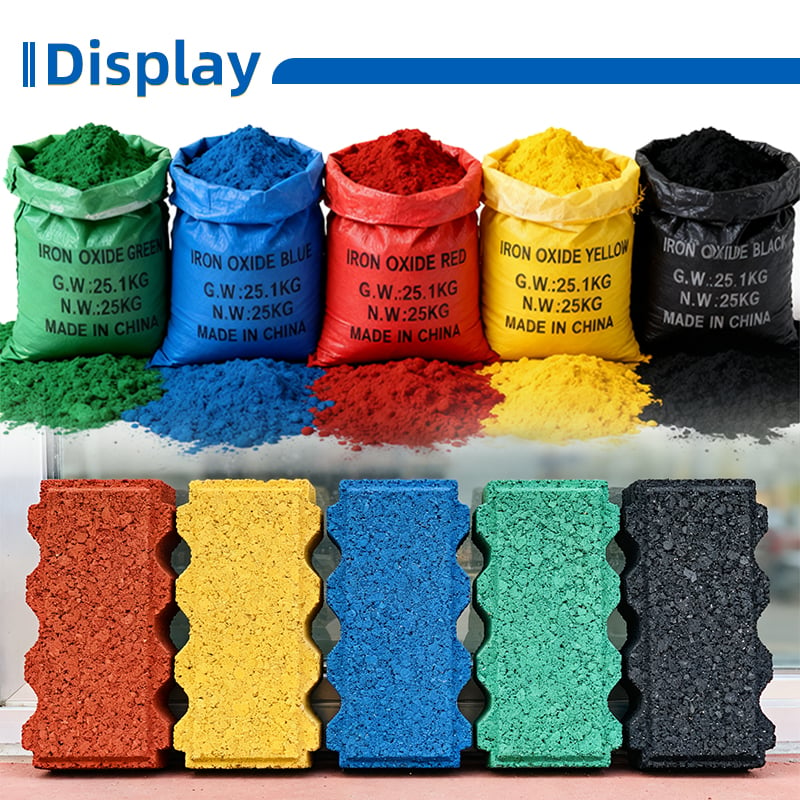
Iron oxide pigments for concrete are used in paving stones, roof tiles, blocks, precast products, mortars, renders and integrally colored concrete. Iron oxide pigments are dispersed through the cementitious mix to create color that becomes part of the product rather than a surface-only decoration.
Color is influenced by pigment dosage, cement color, aggregates, water-to-cement ratio, curing and surface finishing. Construction buyers should test the selected pigment in the actual mix and keep production conditions consistent. Where a project refers to standards such as ASTM C979/C979M, the buyer should confirm the current requirements and obtain appropriate evidence for the offered grade.
Iron oxide pigments are used in architectural and industrial coatings for color, opacity and exterior durability. Red grades also appear in primers and protective coatings, while transparent grades can create warm effects in specialty finishes.
Formulators should evaluate iron oxide pigments for undertone, tinting strength, particle size, dispersibility, oil absorption, viscosity and gloss. The actual resin, solvent or water system, dispersant and milling equipment should be used in trials.
In plastics, suitable iron oxide pigments provide inorganic color for molded products, profiles, films and masterbatch. Selection depends on polymer type, processing temperature, color target, dispersion and regulatory requirements.
Heat stability is especially important because yellow or black grades may behave differently at elevated temperatures. Buyers should request grade-specific thermal information and conduct molding or extrusion trials under realistic conditions.
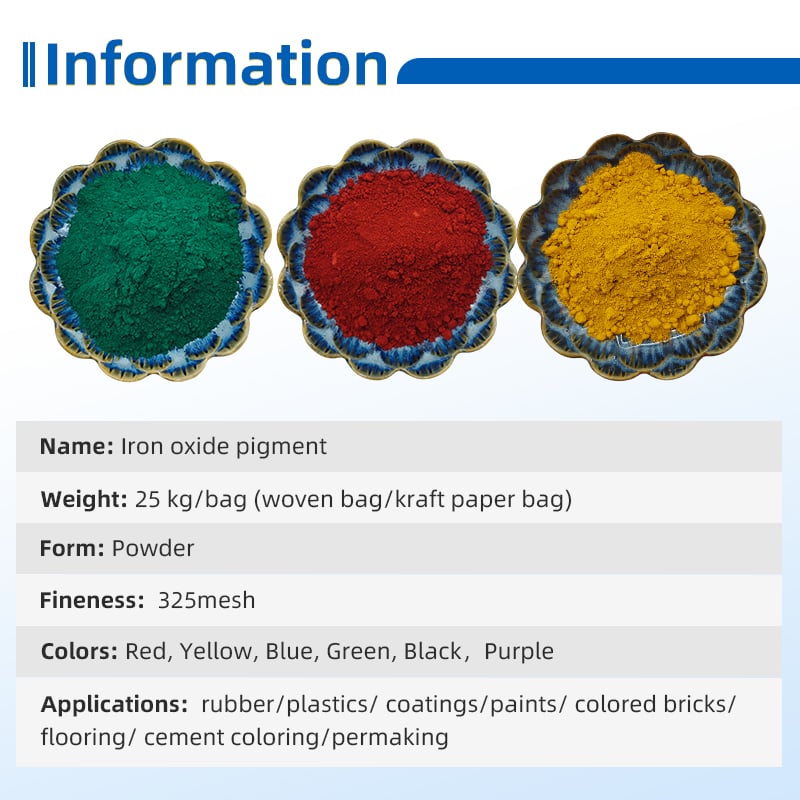
Selected iron oxide pigments can color rubber flooring, molded parts and other elastomer products. The pigment must be compatible with the compound and cure system. Dispersion, shade, contamination and effects on processing should be evaluated in the complete formulation.
Application-specific iron oxide pigments are used in ceramic bodies, glazes, art materials and other specialty products. Firing conditions can change the oxidation state and resulting color, so ceramic customers should test the grade at the intended temperature and atmosphere.


