×
×
Wollastonite powder is a functional calcium silicate mineral used by manufacturers in ceramics, plastics, paints, friction products and metallurgical formulations. This buyer-focused guide from [Company Name] explains what the mineral is, why its needle-like particle shape matters, which specifications purchasing teams should compare, and how to select the right grade for a specific production process. For importers, distributors and industrial buyers evaluating an overseas wollastonite supplier, understanding purity, particle size, aspect ratio, brightness and loss on ignition is essential before requesting samples or placing a bulk order.
Wollastonite powder is produced from a naturally occurring calcium metasilicate with the chemical formula CaSiO₃. According to the U.S. Geological Survey, its theoretical composition is 48.3% calcium oxide and 51.7% silicon dioxide, although natural material may contain trace or minor amounts of aluminium, iron, magnesium, manganese, potassium and sodium. These impurities, together with processing quality, can influence colour, brightness and suitability for demanding applications.
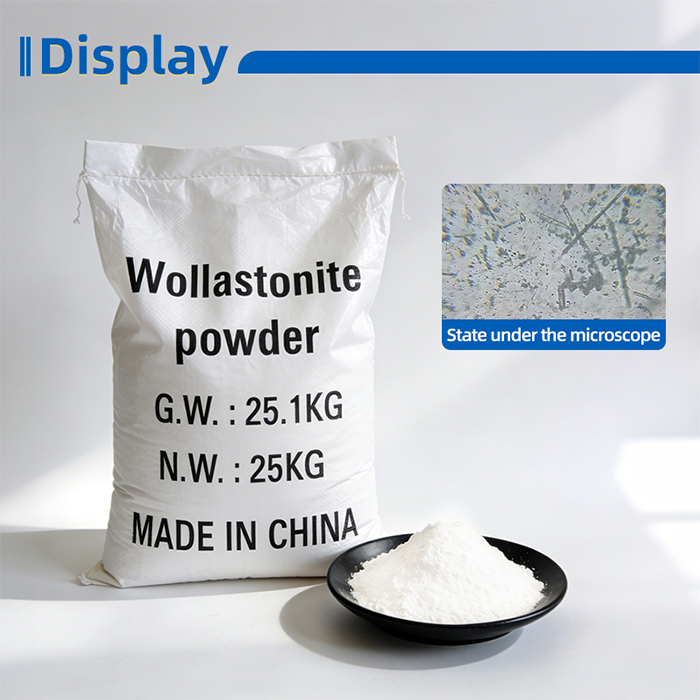
During crushing and milling, the mineral tends to split into lath-shaped or needle-shaped particles. This acicular structure distinguishes it from many conventional mineral fillers. Instead of serving only as an inexpensive volume extender, properly processed wollastonite powder can reinforce a formulation, support dimensional stability and contribute useful thermal or processing characteristics.
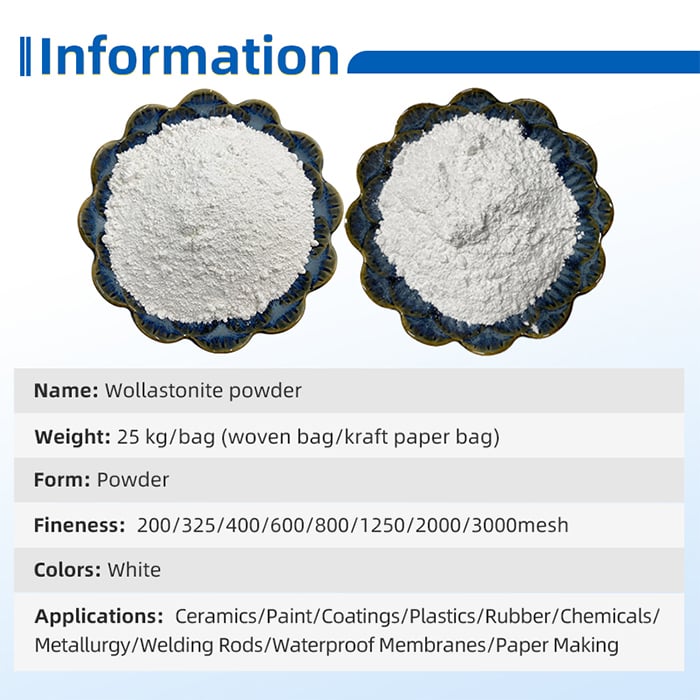
Industrial wollastonite powder is normally beneficiated and milled to remove associated minerals and create grades with different particle sizes and aspect ratios. Some grades may also receive surface treatment to improve compatibility with polymer resins. The best product is therefore not simply the finest or whitest option; it is the grade whose morphology and chemistry match the customer's formula and equipment.
The aspect ratio describes particle length relative to diameter. The U.S. Geological Survey notes that low-aspect-ratio particles may be around 3:1, while high-aspect-ratio products can reach about 20:1. Higher-aspect-ratio wollastonite powder particles can act like microscopic reinforcing elements in plastics, paint films and unfired ceramic bodies. A buyer seeking reinforcement should therefore compare aspect-ratio data rather than relying on mesh size alone.
Loss on ignition, commonly abbreviated as LOI, indicates how much volatile material is released when a sample is heated. USGS technical information reports a low LOI range for commercial wollastonite powder, which helps reduce gas-related defects during ceramic firing. For ceramic bodies and glazes, this can support faster gas release and more stable firing performance, subject to the customer's formula and production conditions.
Pure wollastonite powder is bright white, while natural impurities can produce grey, cream, brown, pale-green or red tones. High-brightness grades have less influence on the colour of finished products, making them useful in white or lightly coloured plastics, coatings and ceramic formulations. The mineral is also largely inert in normal manufacturing environments and remains useful across applications that require dimensional, thermal or chemical stability.
In ceramic bodies, glazes, frits, enamels and sanitary ware, wollastonite powder provides calcium and silica in a low-volatile form. Its acicular particles can strengthen green ceramic bodies, while low LOI supports earlier gas release during firing. USGS information also identifies reduced warping and cracking, increased strength and improved firing performance among the reasons manufacturers use this material.
Before selecting wollastonite for ceramics, buyers should evaluate CaO and SiO₂ content, Fe₂O₃ level, particle size, LOI and firing behaviour. The correct grade depends on the ceramic body recipe, firing temperature, desired whiteness and surface finish. Laboratory testing with the customer's own formulation remains necessary before bulk adoption.
In nylon, polyester, polyurethane and other polymer systems, acicular wollastonite powder can function as a reinforcing filler. The Essential Minerals Association describes benefits that may include improved durability, dimensional stability, electrical insulation and resistance properties. Surface-treated grades are often considered when stronger adhesion between the mineral and polymer matrix is required.
Plastics buyers should ask whether the quoted grade is untreated or surface modified, and request data on aspect ratio, particle-size distribution, moisture and surface-treatment chemistry. Processing method, resin type and target mechanical properties should guide the final selection.
In paints and coatings, wollastonite powder may contribute reinforcement, film toughness, hardening, low oil absorption and crack resistance. Its white colour can reduce unwanted colour influence, while the interlocking particle structure may support scrub, weather and corrosion resistance in suitable formulations. It may also work as a functional extender or flattening agent, depending on particle shape and fineness.
Paint formulators should compare brightness, oil absorption, pH, particle-size distribution and aspect ratio. The effect on viscosity, gloss and pigment loading needs to be validated through formulation trials rather than assumed from a generic technical data sheet.
Wollastonite powder is used as a reinforcing additive in friction materials such as brake and clutch formulations. It has also been used as an asbestos substitute in selected insulation boards, panels, roofing products and related construction applications. In metallurgy, wollastonite can form part of formulated powders for steel casting and welding because of its calcium silicate chemistry, low LOI and useful behaviour in flux systems.
Application suitability depends on the full formulation and relevant safety or performance requirements. Buyers should confirm that the supplier's specific grade has been tested for the intended end use.