 ×
Published: November 2, 2026 | Last Updated: November 2, 2026
SEO Title Tag: Ceramic vs Resin vs Glass-Ceramic Luminous Stone | Huabang Meta Description: Luminous stone is sold under one name but built on four different matrices. How ceramic, resin, glass-ceramic and coated aggregate actually behave, and how to choose.
A landscape contractor in Rotterdam specifies luminous stone for a hotel walkway. A resort developer in Dubai specifies the same product for a pool deck. Both receive a quotation for "photoluminescent aggregate, 3–6 mm, yellow-green, 8–12 hours". One installation is still glowing after four winters. The other has faded within eighteen months, and the supplier blames the installation rather than the material.
The difference is that luminous stone is not one product. Under that name the trade sells at least four distinct constructions — a sintered ceramic, a cast resin, a glass-ceramic, and a coated natural aggregate — with different hardness, different weather resistance, different afterglow behaviour and very different cost structures. They are quoted in identical language, which is why the comparison is usually decided on price per kilogram and then regretted. This guide sets out what separates them, which numbers actually predict performance, and how to choose by application.
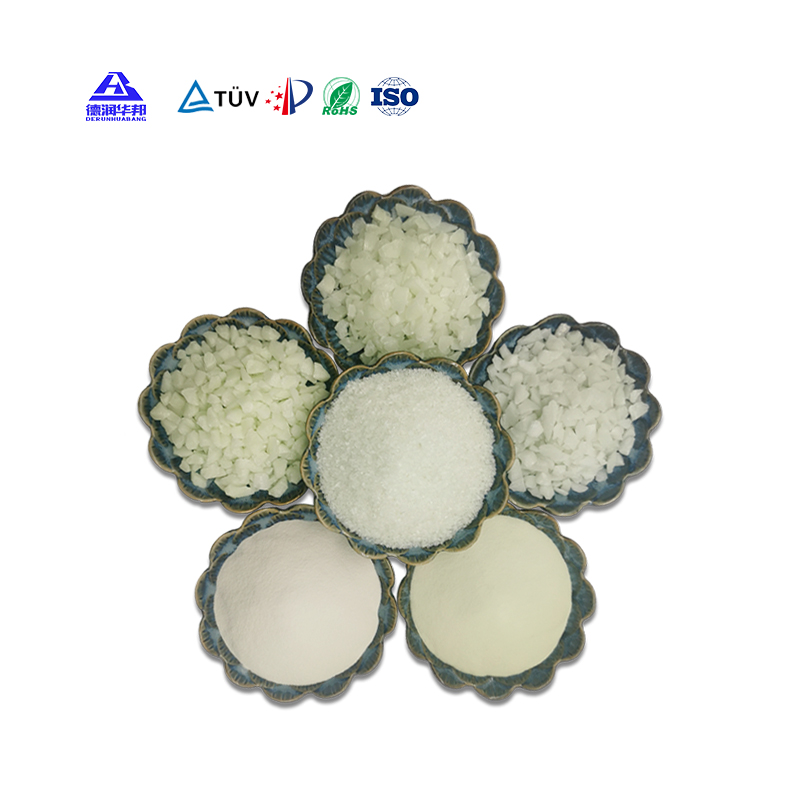
All four work by photoluminescence. A rare-earth activated aluminate or silicate — most commonly strontium aluminate doped with europium and dysprosium, SrAl₂O₄:Eu²⁺,Dy³⁺ for the familiar yellow-green, or a higher-alumina phase for blue-green — absorbs visible light, traps part of the energy at defect levels, and releases it slowly as visible light once the source is removed. The dopant pair matters: europium provides the emission centre, dysprosium the trap depth that stretches the afterglow from minutes into hours.
Two consequences follow. First, the phosphor is the expensive component, and how much of it a product contains, and at what grade, decides most of the price and nearly all of the performance. Second, the matrix decides whether the phosphor survives contact with the world. A perfect phosphor in a soft matrix will still be gone in two seasons.
Modern photoluminescent materials are not radioactive. The luminous paints of the mid-twentieth century used radium-226, promethium-147 or tritium; rare-earth aluminate phosphors contain none of these, which is why they are acceptable in schools, hospitals and children's products. Any supplier claiming "self-luminous without light charging" is describing a different and older technology.
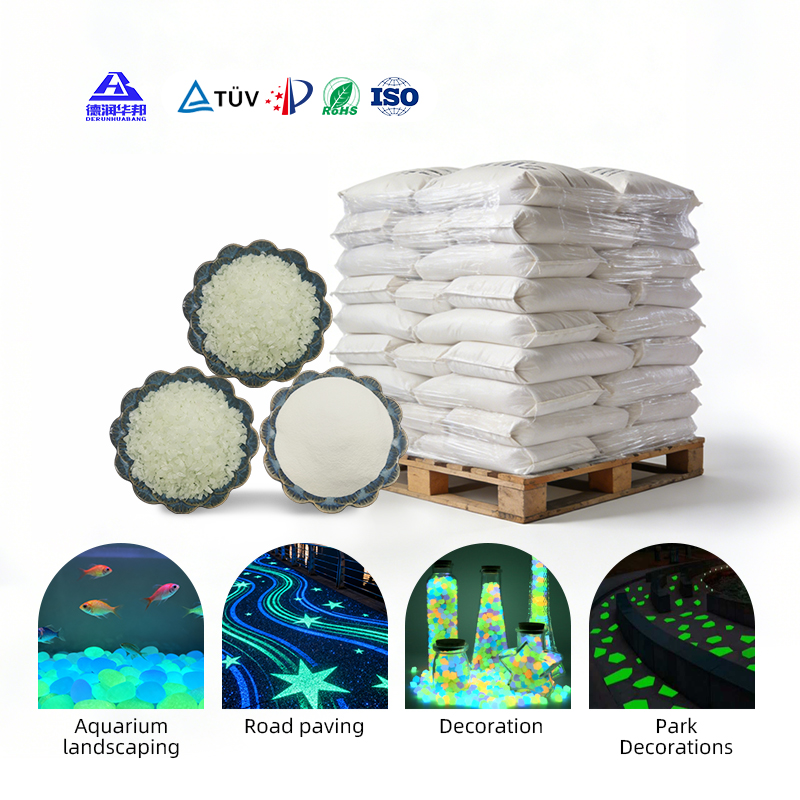
High-purity alumina and silicate raw materials are blended with phosphor, formed and fired at high temperature, then crushed, graded and given a waterproof surface treatment. The ceramic body is dense and glassy, with Mohs hardness around 6 to 7 — comparable to feldspar, harder than most decorative stone. It resists abrasion, UV, frost and freeze-thaw cycling, holds colour, and does not chalk. This is the only construction that should be specified for permanent outdoor paving, vehicle traffic, pool surrounds and public infrastructure. It is also the most expensive and the most limited in colour, because the sintering temperature constrains which phosphors survive.
Phosphor and colourant are dispersed in a resin system, cast, cured and cut. The result is light, tough, impact-resistant, easy to cut and bond, and available in a much wider colour range — red, pink, violet, blue — because curing happens at low temperature. It is the right material for aquariums, terrariums, resin art, jewellery and indoor feature work. It is the wrong material for anything that sees sustained sun or foot traffic: the polymer matrix yellows under UV, scratches, and abrades faster than ceramic, and afterglow in service typically falls to 6–8 hours rather than the 8–12 hours claimed for ceramic. Suppliers who quote one figure for both are simplifying.
A partially crystallised glass, made by controlled heat treatment. It sits between the other two: harder and more chemically durable than resin, able to be produced translucent or in larger moulded shapes, but with less abrasion resistance than a fully sintered ceramic and a narrower supply base. It is uncommon in export catalogues and should be treated as a specialist option, specified against measured data rather than a general claim.
Crushed stone or mineral is coated with a phosphor-bearing layer. This is the cheapest construction and the one that most often disappoints. The glow comes from a thin surface film, so abrasion removes it directly; the coating can craze or lift with thermal cycling; and afterglow falls away faster than in any of the other three. It has a legitimate use in dry decorative work and short-life display, and no legitimate use in paving.
A related substitution deserves a warning. Fluorite is sometimes offered as a low-cost "natural luminous mineral". Fluorite is fluorescent, not phosphorescent: it emits only while a UV source is on it, and stops the moment the source is removed. It will not mark a path overnight, and it cannot be substituted for luminous stone in any application that depends on afterglow.
| Property | Sintered ceramic | Cast resin | Glass-ceramic | Coated aggregate |
|---|---|---|---|---|
| Matrix hardness | Mohs 6–7 | Low, polymer | Between ceramic and resin | Substrate-dependent |
| Weather and UV | Excellent, frost-proof | Poor in sustained sun | Good | Coating-dependent |
| Abrasion under traffic | High resistance | Low | Moderate | Low, film wears |
| Typical afterglow | 8–12 h | 6–8 h | Intermediate | Lower, declines |
| Colour range | Limited (blue-green, yellow-green, aqua, white) | Wide, including red and violet | Moderate | Wide but less stable |
| Water and chlorine | Good | Good in fresh water | Good | Coating-dependent |
| Best use | Outdoor paving, egress, road | Indoor, aquarium, craft | Specialist architectural | Dry display only |
Afterglow hours alone cannot rank two suppliers, because the number depends entirely on how it was measured. Ask for brightness at fixed points after the light source is removed — commonly ten minutes and sixty minutes — in mcd/m², with the excitation conditions stated, and reference the measurement to a recognised method such as DIN 67510 for phosphorescent marking or the equivalent rare-earth long-afterglow standard. A supplier who reports one number at one time point, with no method, is reporting a marketing figure.
Size is where budgets are lost. For the same mass, the number of particles rises with the cube of the diameter while the area each covers rises with its square, so coverage area per kilogram scales roughly inversely with particle size. A 1–3 mm grade covers approximately three times the area of a 6–10 mm grade at equal weight.
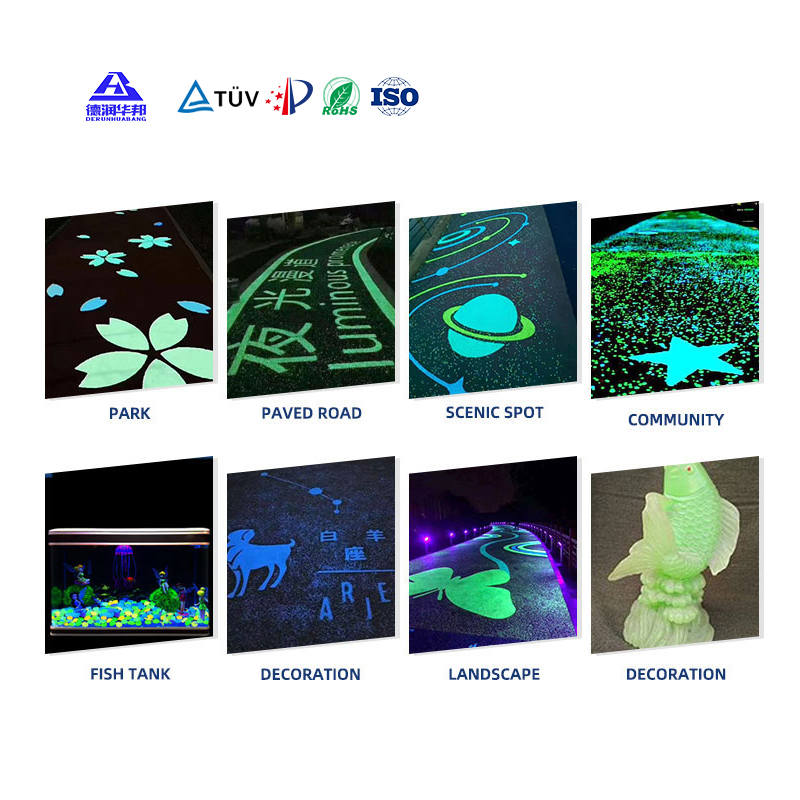
That makes 1–3 mm the economical choice for resin-bound paving and exposed-aggregate concrete, where the stone is broadcast into a binder; 3–6 mm for terrazzo, tiles and larger decorative panels; and 6–10 mm for loose scatter and planter edging, where the visual effect comes from individual stones. Luminous stone is normally blended into a decorative aggregate rather than used as the entire surface — a blend in the region of 5% to 20% by weight produces the effect in most projects. Because binder colour, exposure depth and blend ratio all change the result, the ratio should be fixed on a trial panel before production, not calculated on paper.
A lot certificate with afterglow brightness at stated time points and method, particle size distribution, and moisture. A heavy-metal and radioactivity statement, not a marketing line — the point of a rare-earth phosphor is that it replaces radioactive materials, so it should be easy to evidence. REACH and RoHS declarations for the destination market, an MSDS, and where the project requires it, the afterglow class certificate for egress use. For ceramic grades, ask additionally for hardness and a wear test, because that is what separates a paving material from a decorative one.
1. Is luminous stone radioactive? No. Modern luminous stone uses rare-earth activated aluminate or silicate phosphors, which contain no radioactive isotopes. Radioactive self-luminous materials belong to an older technology based on radium, promethium or tritium. Ask any supplier for a radioactivity statement in writing.
2. How long does luminous stone glow? Sintered ceramic typically 8–12 hours, cast resin 6–8 hours, after 10–20 minutes of charge under daylight or strong artificial light. The figure is only meaningful with the measurement method attached.
3. Can it replace path lighting entirely? It provides low-level guidance, not illumination. It marks an edge, a route or an escape path for pedestrians already adapted to darkness; it does not light a working area. For safety-critical routes, treat it as a supplement to compliant lighting, not a substitute.
4. Why has my installation stopped glowing evenly? Usually one of three causes: a coated aggregate whose surface film has worn, a resin product degraded by UV, or an uneven blend that left phosphor-rich patches and bare ones. Ceramic grades fail by gradual dimming over a decade, not by patchy loss.
5. Ceramic or resin for a coastal resort? Ceramic for every trafficked and sun-exposed surface, including pool decks where chlorine and salt are present. Resin only for interior and sheltered decorative elements, and expect its colour to shift under long UV exposure.
6. What is the minimum order? Sample quantities of a few kilograms are normally available for panel trials; production orders are quoted against the grade, the particle size, the blend requirement and the packing. Send the drawing or the specification and we will quote against it.
Send the application, the traffic and weather exposure, the particle size you have in mind and the afterglow class the project requires. The Huabang technical team will identify the matrix that fits, confirm the afterglow and hardness figures for the lot against the stated method, and supply a sample for a trial panel so the blend ratio can be fixed before the first order.


