×
×
Published: September 2, 2026 | Last Updated: September 2, 2026
Kaolin clay, also called china clay, is an essential industrial mineral for ceramics, paper, paint and dozens of other manufacturing processes. In this buyer-oriented guide from [Company Name], we explain what kaolin clay is, compare the main types — washed kaolin, calcined kaolin and surface-modified kaolin — review the key technical specifications that determine grade quality, and share practical tips for choosing a reliable kaolin supplier. Whether you are a ceramic plant owner, a paper mill purchasing agent, or an independent e-commerce buyer sourcing industrial kaolin powder for the first time, this article helps you make the right sourcing decision.
Kaolin is a soft, white industrial clay composed mainly of the mineral kaolinite (Al₂Si₂O₅(OH)₄). It was formed over millions of years by the natural weathering of aluminium-rich rocks such as feldspar and granite. The name comes from Gaoling ("High Hill") in Jiangxi Province, China, where the clay was first mined centuries ago for porcelain making — which is why it is still widely known as china clay today.
Its commercial value comes from a rare combination of properties: high natural whiteness and brightness, fine and uniform particle size, chemical inertness, low abrasiveness, low electrical conductivity and stable behaviour under high temperature. No two deposits are identical, however. The right grade for your production line depends on your application and on the processing the raw mineral receives, which is why understanding the main product families matters before you contact any supplier.
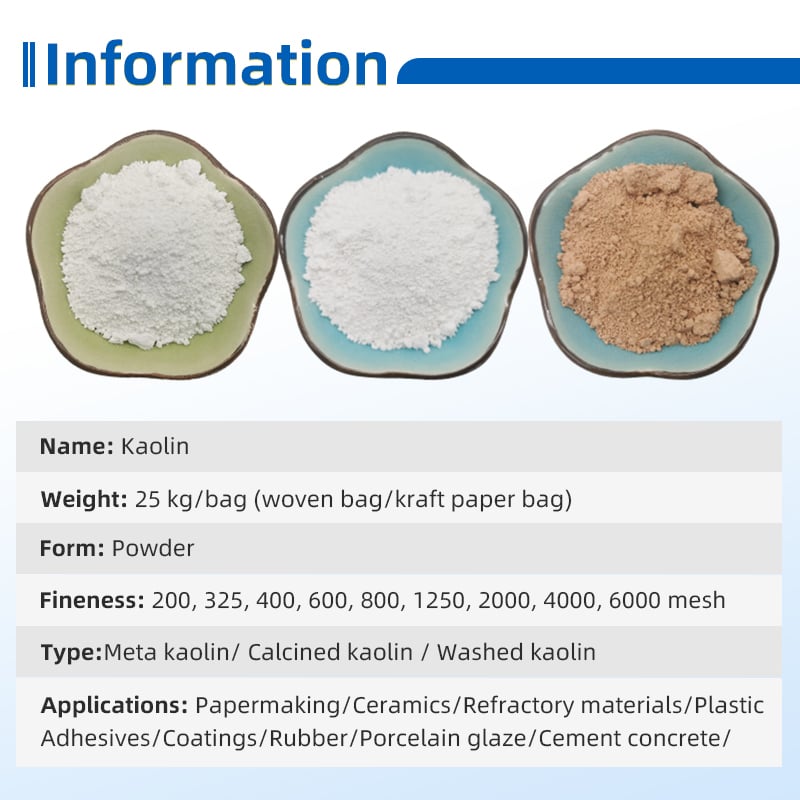
Raw kaolin rarely meets industrial requirements as mined. Producers refine it in different ways, creating three product families you will meet when sourcing kaolin powder:
Washed kaolin is refined with water to remove sand, mica and other impurities, then classified to control particle size and brightness. It is the most widely used family, serving ceramics, paper filler and coating, rubber and everyday porcelain tableware. If your process needs plasticity, green strength and controlled fired whiteness, this is usually the grade to start with.
It is heated to high temperature — typically 650 to 1100 °C — to drive off the water locked inside the crystal structure, yielding much higher brightness, whiteness and electrical resistivity. Calcined grades are prized in paints and coatings as a cost-effective TiO₂ extender, in paper coating, in wire and cable insulation, and in refractory applications where thermal stability matters.
Surface-modified grades are treated with coupling agents such as silane so the mineral bonds better with organic polymers. They are used mainly in rubber and plastics, where they improve mechanical strength, abrasion resistance and processing performance — a common choice for rubber seals, hoses, cable compounds and engineering plastics.